Tuesday, August 20, 2013

The true role of a central bank

At the Princeton graduating ceremony in June 2013, Ben Bernanke in his commencement address admitted to the graduating students how economics had failed to read the future:
“Economics is a highly sophisticated field of thought that is superb at explaining to policymakers precisely why the choices they made in the past were wrong. About the future, not so much. However, careful economic analysis does have one important benefit, which is that it can help kill ideas that are completely logically inconsistent or wildly at variance with the data. This insight covers at least 90 percent of proposed economic policies.”
The prognosis failure is a serious indictment of the economics profession. Yet Bernanke had the gumption to claim that economics was able to correctly explain the past. Had this remark been made of any other knowledge discipline, that discipline would have been ridiculed for its claimed robustness despite failure in predicting the future. As for the past, anyone can rationalise why things unfolded any which way. In fact, economists are no different from lawyers, every one of them believes in the correctness of his own opinion despite wide and deep differences between every one of them. The only valid test for an economist's opinion is how close it is in predicting the future, and in this respect most economists' reasoning would fail scrutiny.

With this kind of shaky grasp of major economic events, economists are ill suited to the task of running a country's central bank. You don't need an economist who is too clever by half to control the monetary policy of a country. Instead the job must be made foolproof enough for a fool to handle it.

But an economist, or anybody for that matter, can run a commercial bank because money is the easiest thing to sell, or rather lend. You really don't need to convince buyers to buy as money sells by itself. The only time you can't sell money is when prices are falling because the collateralised asset will be worth much less than the borrowed amount. That's why banking requires persons with conservative demeanour, not flamboyant salesmen nor smart brains. As banking uses other people's money (OPM), technically there's no limit on how much you can borrow and lend. But more loans lead to more risk. Herein comes the role of the central bank, that is, to ensure that all the lenders in the country do not borrow and lend money beyond what they can absorb in potential losses.

As for a central bank, do we need it in the first place? In my earlier post, I've argued that the objectives of the Fed as set out by Congress are all unattainable. Those objectives however don't include the received wisdom about the role of a central bank, that is, as a lender of last resort. This is equally wrong because first, it distracts the central bankers from their real role and second, it requires colossal financial resources.

As a lender of last resort, a central bank subverts the role of the executive and the legislative assemblies as only these two branches of government have the right to decide whether the government should bear the cost of massive bank bailouts. A central bank is not answerable to the electorate and cannot spend money willy-nilly even though it can print as much money as it wants. Printing money and spending money are two unrelated issues which have confused many economists. If printing can be equated with spending, Obama wouldn't have any problem with sequestration.

What then should be the role of a central bank? The US used to live without a central bank for a long time. In fact, the Federal Reserve was only set up in 1913. Before the existence of the Fed, the only semblance of a central bank that the US ever had was the short-lived First and the Second Bank of the United States (BUS) which were chartered in 1791 and 1816. These were private banks run on a commercial basis but both didn't last beyond their 20-year charters. They didn't get their short lives extended primarily because many people were envious of private organisations enjoying benefits from the federal government. The First BUS wasn't really a central bank in the modern-day sense as its original purposes were to issue notes, pay off the war debts as well as offer commercial loans at a time when there was a dearth of commercial banks. Its notes were in demand as they were accepted for tax payments.

Soon after the demise of the First BUS, the War of 1812 erupted between the US and Britain, stimulating the need for money. Many state banks were established leading to the proliferation of their own unique banknotes, and in its wake, rising inflation. The problem was compounded when the banks of the southern states suspended redeemability in specie (gold or silver coins). Because of this crisis, the US government decided to reestablish the BUS.

As the US government kept its deposits with the BUS, its banknotes had an implicit sovereign backing, enabling them to be accepted at face whereas those of other banks would be discounted. This function of providing a uniform currency however is not the sole preserve of a central bank; the Treasury can perform this role. The easiest way of effecting this is for the government to back the currency. Demand can be created by insisting that taxes be paid using the bank's notes. Had the US government in the early years of the republic settled on a uniform currency, the confusion created by having to fix the discount rate of other banknotes or trying to figure out whether the banknotes were valid would have been unnecessary.

Another central banking role performed by the Second BUS is more relevant. As the Second BUS was the collecting agent for the federal government revenues, it received a large volume of state banks' banknotes. Also, the Second BUS monitored the foreign exchange rate of the US dollar. If the rate went down, it meant that there was too much money (or credit), so it would redeem the banknotes of the respective state banks in specie. As a result, the state banks tended to be cautious in making new loans as it would mean more of its banknotes would be in circulation and a higher need for specie should the banknotes be redeemed.

This role, that is, ensuring that banks don't increase their lending indiscriminately is more important than being a lender of last resort. As mentioned earlier, banks have a morbid tendency to keep increasing their loans since the source of funds is other people's money. Without adequate checks from the central bank, the leverage ratio would quickly multiply, creating a debt mountain that will eventually collapse. Had a central bank carried out its more important role of crimping credit creation in the first place, a lender of last resort role is superfluous.

A good analogy is to picture the central bank as a prison warden and the banks as prisoners. The prisoners are always on the lookout for escape, which in the case of banks means to lend more and more using OPM. The warden's job is to curtail such tendencies through regular checks and audits. For those that manage to break out, the warden has to impose penalties upon capture. The demands imposed on these tasks require the full-time attention of a warden, to wit, a central bank.

A monetary collapse is further facilitated in a specie based monetary system. Actually a specie based system can never be fully backed by specie, typically represented by gold or silver or both, since there is never enough gold or silver to back all the currency notes in circulation. It's an anachronistic system which should have been abandoned long ago. This was demonstrated by the 1819 panic, the first financial crisis in the US.

In this panic the Second BUS was not irreproachable. Along with the state banks, it contributed to the 1819 panic because of excess debt. Napoleon also sowed the seeds of this crisis. Because of Napoleon's need for cash for his European wars (1803-1815), he sold Louisiana — actually all or part of 15 states right from the Canadian border to the Gulf of Mexico — to the US government for $15 million in 1803 (see the orangish bit on the Wikipedia map below). With that, the barrier to the westward expansion of the US was lifted. Also because of the Napoleonic Wars, the US gained from trade surpluses arising from exports to Europe but as the wars ended, Europe made a recovery in its agricultural production in 1817. Cotton also had a new competitor from India, resulting in big drops in cotton prices. The surpluses now turned into a deficit, causing specie to outflow. Furthermore, the US government in 1818 wanted to redeem in specie $2 million worth of bonds that had been raised for the Louisiana purchase. This meant that the credit overextended during the surplus years had to be called in, causing farms and businesses to foreclose.

File:LouisianaPurchase-fr.png


We can glean two important lessons from the crisis recovery. First, the policymakers suspended specie redemption, thus expanding credit. Any credit contraction crisis can be solved by unshackling credit provided there is enough consumption (people with incomes) to offload capacity. Otherwise the excess credit would go towards funding asset investment which will be written down once deflation takes root. Second, relief was extended to debtors instead of creditors, through the Relief of Public Land Debtors Act of 1821 in which buyers of government land were allowed to keep the proportion of land they had paid and relinquish the balance.

But in the present crisis, the government has gone out of its way to protect the banks. The creditors are the winners, and winners will continue to win as long as we are still in the same Kondratieff Wave. An absence of government help represents only a minor setback to the winners but to the losers, that is, the borrowers, it can be a difference between living on food stamps and living on food kitchens.

The 1819 panic was however a mild foretaste of the more calamitous 1837 panic. Even before the Second BUS's charter lapsed in 1836, the federal government had started transferring its deposits to the state banks from 1833. Flushed with these deposits, the state banks went on a lending binge, especially in financing the westward expansion land sales. These land sales enabled the US government to pay off all its debts — probably the only time it was able to so. However whenever a government has its accounts in surplus, unless it's a small city-state, the surplus spells economic troubles ahead as the private sector would've been deep in debt. By 1836, President Andrew Jackson, troubled by deposits not backed by specie insisted that land sales be made in specie. The specie was withdrawn from many banks and deposited with the land offices or banks of the western border states. As a result the banks suffering from specie withdrawals had to curtail their lending by calling in their outstanding loans, leading to a drastic drop in credit.

Exacerbating this situation was the canal and railway booms — remember that the US had a late start in canal building relative to Britain but its railways, or railroads as the Americans call them, were still in their early stages as reflected in their use of iron instead of steel — in which debt was the driving force. Although no records of credit issued were available, we can safely assume, given the three major investment mania of land, canals and railways running concurrently, that credit outstanding was substantial and had to fall drastically. It was this fall that led to a 7-year deflation, which actually was the first Great Depression.

Economic recovery was only felt in 1844 when trade revived as a result of crop failure in Europe, and debt liquidation no longer took hold. The repeal of Britain's Corn Laws in 1846 fostered the growth of US grain export. Elsewhere on the European continent, bad harvests in 1845 and 1846, followed by restrictive monetary policies to slow the loss of reserves led to the breakout of revolutions which almost toppled many governments across several countries.

In the US, recovery was further boosted by the Mexican-American War (1846-1848), the victory of which allowed the US to seize from Mexico territories ranging from Texas all the way to California. The new territories would lift the economy much later but for now, the immediate boost came from the war spending. In 1847 the federal deficit increased to $31 million, the largest deficit since the founding of the US Republic. Defence alone soaked up $48 million of the $61 million spending in that year. The deficits regressed but continued till 1849, at a time when the norm was federal surpluses arising from land sales. Now, who said that military spending or a budget deficit could suppress the economy? The deficits created credit or money but in the present crisis, that option is no longer available as there is no silver lining, in the form of future income windfall, to offset the massive debts that most governments have piled on.  The Second Kondratieff Wave technologies of railways (steel-based) and telegraph appeared right on cue to link the vast distances from the Atlantic to the Pacific, symbolised by the pounding in of the Golden Spike in Utah in 1869.

In all these events, no central bank was needed to hasten the recovery process. Again important lessons cannot be missed on how the impact of the depression was mitigated. A short-lived Bankrutptcy Act became law in 1841 though it was repealed in 1843 but within its brief existence, it managed to wipe out $450 million worth of debts owed to a million creditors. Though it was the second bankruptcy act, it was the first to provide for both voluntary bankruptcy and individual debtors instead of just merchants and traders. Still, it discouraged investors from making new loans though the lessons from history tell us that their fears will vanish once good investment opportunities appear. In alleviating the sufferings, borrowers deserve more assistance than creditors.

In a future post, we'll continue with how the Fed came to being following a crisis that was resolved by a lender of last resort and how that continued to guide the Fed's actions. The Fed has no memories of how curbing of runaway credit growth would've been the more appropriate role for it.

Monday, August 19, 2013

Why debt will not burn away

If the current monumental debt load refuses to be wiped out, why not set fire to the whole lot and the whole world would be free of the debt burden. It sounds so simple that it makes one wonder why politicians and policymakers are so dumb as to overlook this obvious solution. Well, as the old adage has it, "If it's too good to be true, it probably, no, make it, surely is."

Ambrose Evans-Pritchard, an economics columnist with Britain's Daily Telegraph has been suckered by this nostrum when he writes the following blog piece, "Just set fire to Japan's quadrillion debt", that was published on 9th August 2013:
As you may have seen, Japan’s public debt has hit one trillion quadrillion yen. That is roughly $10 trillion. It will reach 247pc of GDP this year (IMF data).

No problem. Where there is a will, there is a solution to almost everything. Let the Bank of Japan buy a nice fat chunk of this debt, heap the certificates in a pile on Nichigin Dori St in Tokyo, and set fire to it. That part of the debt will simply disappear.

You could do it as an electronic accounting adjustment in ten seconds. Or if you want preserve appearances, you could switch the debt into zero-coupon bonds with a maturity of eternity, and leave them in a drawer for Martians to discover when Mankind is long gone.

Shocking, yes. Depraved, not really.

It also doable, and is in fact being done right before our eyes. That is what Abenomics is all about. It is what Takahashi Korekiyo did in the early 1930s, and it is what the Bank of England is likely to do here (while denying it), and the Fed may well do in America.

Japan’s QE will never be fully unwound. Nor should it be. If a country can eliminate a large chunk of unsustainable debt without setting off an inflation spiral, or a currency crash, or the bubonic plague, there has to be a very strong reason not to do it. I have yet hear such a reason. Though I have heard much tut-tutting, Austro-outrage, and a great deal of pedantry.

It is also what the Romans did time and again over the course of the late empire, though less efficiently, since they did indeed inflate. And no, even that was not fatal. The Roman Empire did not collapse because of metal debasement. It revived magnificently under the Antinones. As Gibbon discovered deep into his opus — and too late to change his title — the Decline and Fall of the Roman Empire took an awfully long time, to the point where the concept is meaningless.

Money is hugely important, but also ultimately trivial. The productive forces of a society are what matter in the end.

Japan’s current debt is roughly the same level as that reached by Britain after the Napoleonic Wars, though Britain produced half the world manufactured goods and controlled half the world’s shipping in the early 19th Century (or at least by 1840), so it had a bigger shock absorber.

Does Japan’s debt matter? Yes, of course it does. A country with a shrinking workforce and surging old-age costs, cannot bear such a load.

The BoJ is currently buying 70pc of the total state debt issuance each month, and my guess is that it will be buying over 100pc before long since the economic rebound will lead to a surge of tax revenues that greatly reduces the fiscal deficit. It will soon enough to be able to carry out some really worthwhile legerdemain.
Now, has Japan burned its debt? On the surface, it appears so but it is really a sleight of hand. Its Japanese government bonds (JGBs) have been taken out of circulation and held by one branch of the government, the Bank of Japan, for debts owed by another branch, its Ministry of Finance. Even if we burn these debts, the Bank of Japan still owes the former holders of the JGBs the exact amount, in the form of BoJ deposits due to them. These cannot be wiped out. The holders of these deposits can even swap them en masse for the US dollars if they no longer have faith in the Japanese yen. That's why Korekiyo Takahashi imposed capital controls in the 1930s when he implemented similar QE measures.

Even assuming that the BoJ buys 100pc of all new JGBs, in return for which the Japanese government will initially own all the new deposits with the BoJ. The Japanese government is not going to sit on these deposits but will spend it to boost the economy. Once spent, the deposits will eventually end up with other financial institutions. So it makes no difference whether old or new JGBs are held by the BoJ because the flip-side of those JGBs, that is, the deposits, will still be held by the financial institutions.

And recent events have proven that Abenomics is really a load of bull. After an initial spurt in economic activity, which really was the outcome of Abe's ¥10.3 trillion stimulus package unveiled in January this year, and aided by a correction in the previous overvaluation of the yen, the Japanese economy will go back to its languid state. Even the yen has refused to depreciate further after finding its steady state. The proposed hike in sales tax next year will dampen the mood further.

There are only three measures that can wipe out the debt, and burning is not one of them. The first option is war and this is becoming a distinct possibility given the worsening economic conditions of both China and Japan. The US which is supposed to play the role of the world's policeman has abdicated this role in the Middle East simply because it is financially broke. The Far East is watching the Middle East with keen interest.

Inflation is an expedient to making the debt become small relative to the economy. Ancient Rome could do that because its productive capacity had reached its limits at a time when population was still growing. Now, Japan is demographically shrinking but its technological capability is not constrained by demographics as it increasingly relies on robots and automation. No, Mr. Evans-Pritchard, it's not just the productive forces of society that matter, it's also its consuming ability. So instead of inflation, it is deflation, which makes debt relatively bigger, that is plaguing Japan. Inflation still besets some countries but they are countries which have lost their productive capacity because of cheap imports from super-efficient producing countries. Do they get their debts whittled down? No, they need more debts to pay for the imports. Inflation is in local currency but debt is in foreign currencies. Talk about a double whammy.

The final option is of course economic growth. But this is no longer possible in the closing phase of a Kondratieff Wave. We can see that debt is growing faster than the economy in virtually all countries.

Can the world slog on in the present manner? Well, if it's too good to be true, it surely is.

Thursday, July 18, 2013

Reading the T leaves

The conflicting messages conveyed by the various economic indicators have created much confusion as to the real direction of the economy. The usual question keeps coming back: Are we heading for the grand depression or are we on the cusp of a great recovery? In the US, as opposed to the rest of the world, things are looking cheerful. Is it possible for the US to be disconnected from the others in a world that is still tightly knit?

Generally, in a recovering economy, all asset classes, such as commodities, stocks, and real estate would increase in value. The only exception is bonds because in good times, most investors will desert fixed income bonds in their search for greater returns from other asset classes. So the value of bonds can be a good indicator of the future state of the economy. As we all know, the value of bonds moves inversely with their yields, the higher the yields, the lower the value and vice versa.

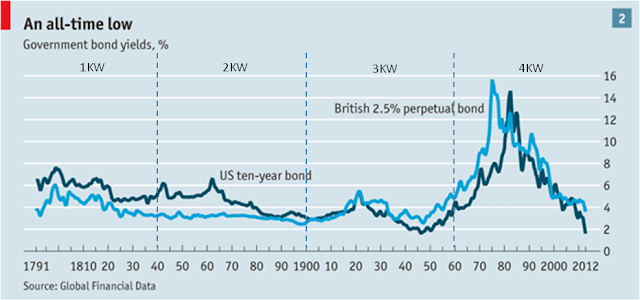
With more than 200 years of recorded historical yields behind it, the 10-year US T-note would make a good choice as a predictor of the US economic fortunes. The graph below from The Economist charts the movements of both British and US bonds. To see the impact of the Kondratieff Waves (KW) on the bond yields, I've delineated the graph into four KW periods using 1780 as the starting point, and estimating each KW to span 60 years. There are no hard and fast rules regarding the periods, these are my ballpark estimates but so far in terms of explaining economic trends and events, they are pretty indicative of the start and end of each KW.


There's also another similar graph below from Goldman Sachs with annotations of key events and the yields when the events arose. It's very helpful as you'll notice that wars don't necessarily contribute to high interest rates. We've been brainwashed that the Vietnam war was a major cause of the high inflationary years, and by extension, the high interest rates, of the late 1970s and early 1980s. We can counter this specious argument with other wars, the US Civil war and the WWII, in which bond yields fell.


Our main concern, however, is to find out whether the T-note yields can provide a useful predictive pattern to how the future will unfold. If you go back to the first chart, you'll notice that in the first half of each wave, the yields would rise only to drop in the second half. Well, almost all except in the 3KW but this was an extraordinary event forced upon by the greatest war ever witnessed.

Ordinarily, we would assume that in the current 4KW, as bond yields have reached their trough since you can't go below zero, there's no other way than up. This is also in line with the economic recovery being felt in the US, bucking the trend in the rest of the world. Not so fast. There's still another option, that is, to meander sluggishly at the bottom. Take a look at the following chart from Bloomberg and you'll realise why the current state is under extreme pressure to snap.

Notice that bond and stock prices generally mirror one another's movements. When bonds go up (that is, yields go down), stocks will go the opposite way. Now both bond and stock prices are still up in the clouds. Such an obvious incongruity in the prices of stocks and bonds will self-correct in due course but which one will give? Without knowledge of the KW pattern recognition, our choice is as good as that of a shaman reading tea leaves. To understand how KW works, we only have to look at the 3KW in the first chart above.

Towards the second half of the 3KW, Hitler inflicted the biggest catastrophe on mankind. But in every tribulation, there's a blessing. The global economy grew at a rapid clip after WWII, especially from the early 1950s to the early 1960s precisely because Hitler handed a clean slate to the postwar generation. Both physical and financial wealth were wiped out. There was a lot of rebuilding to be carried out and the US was generous enough to grant aid, not loans, to Europe in the form of the US$13 billion Marshall Plan. That was on top of an earlier US$12 billion assistance. If you think that's small, both aid amounted to 10% of US GDP then. As for Japan, it rebuilt its industrial strength from the largesse of the 1950-1953 Korean war. Essentially, the growth came from the 3KW, not the 4KW, technologies.

The 4KW technologies, comprising the computers and internet, became widespread only from the early 1990s. Therefore, without WWII, growth would have been sluggish from the 1950s to the 1960s. Likewise, the likelihood of a great wealth destruction under the current circumstances is very slim. The 5KW technological drivers, biotechnology and nanotechnology, are still in their infancy. The current renewable energy initiatives, e.g., electric cars, photovoltaic solar panels, and wind turbines, do not incorporate 5KW technologies. So their incremental technological progress is limited; the substantial cost reduction seen in PV panels is largely through manufacturing economies of scale and brutal price slashing, a result of massive overcapacity.

So economic growth will certainly be elusive. The stack of charts below from The Financial Times illustrate that the returns of both bonds and equities are predicted to be low. For bonds, as the yields are rock bottom, their prices can't go any higher. As regards equities, their price/earning (P/E) ratios are extremely high (see bar number 9 in the bottom left panel chart) relative to the historical norm of the years from 1926 to 2012. Equity prices are also driven by business expectation of a recovering economy. In the US, this has been reflected by three successive monthly increases in the orders for capital goods. However for the whole world,  Standard and Poors has warned of a 5.4% deep contraction in private capital investment in 2014. It's unlikely that the US can detach itself from the malaise besetting the whole world. So between equities and bonds, equities are the more likely to cede ground and snap from their current stratospheric prices.


Still, aside from the increasing private investment, we need to explain why equities for now have been moving in the wrong direction. There are two plausible explanations. First, as explained in my earlier post, Seize money before money seizes up, the corporations have been issuing corporate bonds to buy their own shares, pushing equity prices up in the process. It's a classic Ponzi scheme. You've got to keep on buying to keep prices up, all the while borrowing to finance the buying.

The second is that in many countries wealth destruction is finally catching up on financial wealth. So money is fleeing these countries and flocking to the US in search of a safe haven. I don't have any data to support this contention but as seen on The Economist chart at left, the value of many emerging market currencies have dropped precipitously, suggesting money has fled from these countries. Its destination is surely the US as it appears to be the last refuge in a financially collapsing world. But the wealth holders fail to realise that the threat is not the declining growth in the rest of the world. The 4KW is in its twilight years, it's in its dying stage. It's like a dying man trying to escape death. There's no external threat, it's all within. The economic hardships plaguing the others will soon come to haunt the US. By then, there's no escaping the wealth destruction; if you don't destruct wealth, it'll self destruct.

Wednesday, June 26, 2013

A false sense of omnipotence

In most countries, central bankers seem to be taking on a sage-like role as their deft moves have supposedly staved off an economic recession, or rather, depression. With such an aura, it's thought that they could do no wrong and recessions will be a relic of the past.

On the other hand, there are others, most notably Senator Ron Paul, who have been pushing for the abolishment of central banking. If only those in this camp had highlighted the stupidity of central bankers in failing to grasp the mechanics of money supply, then their call would probably have held sway. Instead they themselves are equally lost in their understanding of money supply, always harping on the beauty of the antiquated gold standard. The gold standard is irrelevant now as it was then.

If these central bank abolishment advocates had studied the first Kondratieff wave, that is, the period in which the US had no central bank, then they would have understood why a central bank was (or wasn't) needed. A detailed account of this wave's depression which unfolded in the 1830s has been written by Alasdair Roberts in his book titled America's First Great Depression.

Before we delve into how the US banking system worked without a central bank, let's check out the objectives of the US Federal Reserve as established by the US Congress in order to see whether they are achievable. If they aren't, we need to come with the true objective of a central bank to ensure its continued relevance. The Fed has only three objectives, to wit maximum employment, stable prices and moderate long-term interest rates. On the surface, they seem logical but if we analyse in detail, they are in all likelihood unattainable.

In real life, we do come across circumstances in which the objectives of whatever we set out to achieve can't be fulfilled because we have no control over the factors that influence the outcome. If we are naive, we will stupidly accept blame for our failure to accomplish the goals. An entrepreneur, on the other hand, is resourceful enough to modify the objectives because his ultimate measure is economic gain. Not so for the Federal Reserve chairman; he's always under the illusion that all powers are in his hands. So it's his prime responsibility to realise the objectives come what may.

Now, let's examine in turn each objective of the Fed to assess its feasibility. First is maximum employment. It is ludicrous for someone tasked with controlling the monetary policy to have any control over the unemployment level. Employment depends on many factors but monetary policy plays only a very minor role, if at all. In the modern world, technology can play havoc with employment. Whether you live in rural or urban areas, you can be priced out even if you're willing to work. Most of the unemployed are not necessarily lazy, it's just that their competitors are machines who can outwork and outsmart them. Where machines can't do the job, work will go to the cheap workers in third world countries. This phenomenon is nothing new: in Ancient Rome and Greece, the populace was laid idle by slaves and grain producing centres in North Africa and the northern shore of the Black Sea. Now you know why globalisation, or regionalisation in the ancient days, is to be dreaded.

Next is stable prices. Central bankers have been deluded by their ability to stymie inflation in the 1980s, though if we look carefully, it wasn't central bankers but increased oil spare capacity causing oil prices to plummet that did the trick. Central bankers were wrongly given credit for which oil was more deserving. Since central bankers still believe this fallacy, they continue to fight consumer or retail price inflation (RPI) when that inflation is truly dead. But asset price inflation lives on and is easily triggered by a sudden surge in credit. As a result of monitoring the wrong inflation, the central bankers were caught flat footed by the escalating prices of real estate, stocks and commodities. The Economist chart above shows how the two types of inflation have diverged since the start of the new millennium.

In fact, this phenomenon applies to almost all countries. The central bankers took their eyes off the money supply (read, credit growth) and the excess money fuelled booms in commodities, stocks and real property. As for retail goods and services, excess capacity has suppressed their prices during the second half of the current Kondratieff wave. So stable retail prices are not the central bankers' doing, they're the consequence of excess capacity brought on by technological progress and globalisation. Add falling population growth to this combustible mix, you'll have a recipe for falling prices. No matter what the central bankers do, including pumping trillions of dollars of QE, prices will continue to drop.

That leaves us with only one objective left, that is, moderate long-term interest rates. Many believe that Bernanke through his QE has the power to dictate interest rates. It appears that he can but in truth, his power to do so is limited, if not non-existent. Some prominent economists, the most popular being Gary Shilling, believe that Bernanke can suppress interest rates for as long as he likes. I used to agree with this view but after having a look at the Fed's balance sheet below and the way interest rates behave, I now have second thoughts.

To understand why it's being accepted that the Fed has been instrumental in suppresing interest rates and inflating home prices, you have to look at the Fed's balance sheets at left. The reality is the Fed's debt holding is only $3 trillion out of total debt size of $57 trillion. What the Fed has been doing through its QE is swapping debt, buying higher interest Treasury bills and Fannie Mae's and Freddies Mac's mortgage backed securities (MBS) in return for zero interest notes or low interest deposits. The deposits are a recent innovation, created out of thin air in 2008. Swapping debts shouldn't have affected the interest rates on the rest of the debts. Check out any college economics texts on whether there's any change in the price of goods when there's no change in the quantity of demand and supply. I doubt so.

Even we can go to extremes, assuming that the Fed buys the whole $57 trillion of debt. If there's no new debt created by Obama, immediately the interest rates would go up as money turns scarce. The holders of the $57 trillion deposits with the Fed (in return for giving up their T-bills and MBS) would not part with their deposits. They would hold fast to it as unlike T-bills and MBS, the deposits would not lose value when interest rates go up.

Therefore, it's an illusion that the Fed dampens interest rates through QE. If you trace the real reasons behind the ultra low interest rates and the recent escalation in home prices, you'll discover that the US government and the private investment firms are the main contributors. Interest rate is the price of money and it's the law of economics that price goes up when demand outpaces supply. As money is essentially credit, only Obama can create money through his massive deficits. Yet when the deficits were more than a trillion dollars annually over the last 4 years, the economy still remained in a slump. This combination of plentiful money and anaemic demand has depressed the price of money. This largely explains for the low interest rates. Bernanke's QE happened to coincide with Obama's deficits sowing confusion as to the real cause of the low interest rates. If Obama hadn't continued with his annual trillion dollar stimulus, Bernanke wouldn't have dared to buy the T-bills. It's because the interest rates would've kept on rising ensuring the continuing drop in the market value of Bernanke's T-bills. The Fed would've been left with staggering losses on its T-bills holding making it technically insolvent.

The Fed's charade is being exposed with the sequestration coming into effect on 1 March 2013. As this year's US deficit is being slashed, money availability is getting scarcer. Look at the Fed's balance sheets above and you can see that the Fed dare not put any new money in T-bills in the 2nd quarter of 2013. As it is, it's bound to suffer large losses with its existing T-bills holding. As per its latest balance sheet, its carrying cost of T-bills and MBS is $200 billion above their par value (shown as Net Unamortised Premium in the balance sheet). Assuming that the Fed will maintain them to maturity, the potential losses that the Fed may suffer is $200 billion, easily wiping out its capital base of $55 billion.

Not to worry, the interest rates will one day drop again. That will occur when all prices start falling, be they consumer goods or investment assets. However, it's the nominal interest rates that will fall. The real rates will remain high as a result of falling prices. The fall in nominal rates will only rescue the T-bills from a sharp drop in market value but it won't protect the Fed's MBS because the MBS are secured on homes, the value of which will definitely crash in line with other assets.

Like its T-bills holding, the Fed's increasing MBS holding doesn't in any way increase the prices of homes nor lower the interest rates. If you look at the Fed's balance sheets above, it has lately increased its MBS more aggresively than its T-bills, adding $200 billion in the last 3 months alone. To see whether this is new MBS or MBS already existing in the market, we have to look at the combined balance sheets at left of Fannie Mae and Freddie Mac.

The figures highlighted in blue above are the mortgage loans of other banks that have been securitised to the two home financing GSEs. Note that since 2011, the amount has hardly budged. So it means that the Fed's MBS addition represents existing MBS of the two GSEs that were held by other investors. Those investors were more than happy to give the MBS to the Fed in return for more secure deposits placed with the Fed. Who's the greater fool in this transaction? Obviously it's the Fed because it's taking on unnecessary risks in home financing. We can see why the Fed is acting so. Since the prices of homes are rising at a blistering pace (see the Case Shiller trio of charts below), the Fed has less to lose compared to investing in T-bills. Note that of the trio below, the % monthly change, that is, the rightmost chart, affords the most predictable pattern.


But why have home prices continued to be on an uptrend in the face of declining money supply? Actually, what's unfolding is money is being siphoned from other asset classes, such as emerging markets, commodities and bonds, to home investment. The New York Times chart at left shows that private investment money is flowing into home purchases at an increasing rate. My earlier post also has charts depicting the decline in property purchases by individual owners and home ownership rate.

The money flowing out of emerging markets also explains why Brazil, Turkey, and pretty soon, other BRICS, the East Asians and the Asean countries are erupting. The protestors are equally confused. Their discontent covers a wide spectrum – corruption, limited democracy and power abuse – but nowhere will you find in the list, disappearing money which is actually  the root of the problem. Every government has its peculiar imperfections; an economic depression magnifies them by many orders of magnitude. Changing government therefore won't be the solution to their grievances.

The bigger question is, can the Fed keep on buying T-bills and MBS? Again, the Fed balance sheet can shed some light. As of 19 June 2013, its T-bills and MBS stood at $2.0 trillion and $1.2 trillion. Compare this with the Fed's puny capital base of $55 billion, this represents a risk asset ratio of less than 2%. If you view from the liabilities angle, the leverage is 41 times after excluding notes in circulation whereas back in 2007 it was only 2 times. This is worse than that of Lehman or Bear Stearns before their collapse. Those failed banks were not supervised and so is the Fed. Bernanke is taking a big risk since it means that it just needs a drop of 2% in the T-bills and MBS value to wipe out the Fed's capital. Likewise, the two home financing GSEs share equally dreadful metrics with the Fed. They are all hanging tenuously on a thread.

It may be argued that since they are all federal agencies, their financial standing is as good as that of the US government. Moreover, the US government has no limits on the amount of money that it can print. This is one common misperception about the financial strength of the US government. The financial standing of the US government does not depend on how much money it can print but, in the late stages of a Kondratieff wave, on how much deficit it is allowed to bear. The main reason why the US dare not intervene in Syria is that it lacks the financial means to carry out the hundreds of sorties needed to neutralise the Syrian air defence system. As it is, its air force aerobatic team has to decline participation in local air shows because of budget constraint. Even Wikileaks has the guts to humble the US government. What more the Chinese and the Russians who are now emboldened to thumb their noses at the US. You are seeing the early signs of the breakdown of the nation-state edifice.

Tuesday, May 28, 2013

From emerging to submerging

Much excitement has been generated by the emerging markets because this is where economic growth is at a time when other markets are in doldrums. Can these markets avoid the problems of a world facing a synchronised economic depression?

The Wall Street Journal has produced several charts (see below) that compare the debt growth of selected advanced economies with those of emerging economies. For the advanced economies, their debt as a percentage of their GDP is declining while that of emerging economies is still growing. This disparity accounts for the seemingly sanguine prospects of the emerging economies.


But take a deeper look into the debt growth and you can discern a clear pattern. The advanced economies have moved further along the debt growth S-curves. The emerging economies are lagging behind but they are all approaching turning points of their respective S-curves. Don't be lulled by the low government debts of these emerging economies. Their precarious situations lie in their private debts. Most of these debts are being used to finance property booms since their export machines have faltered in the face of global excess capacity and falling consumption.

The next chart (from The Financial Times) compares the current situations of the emerging countries with that prior to the 1997 Asian financial crisis. Some of these countries are facing debt situations that are worse than those in 1997. Yet the picture is still incomplete since it doesn't incorporate bond and shadow banking debts. In 1997, they were rescued by the US economy which pumped increasing credit to generate the consumption that offloaded the exports of these struggling emerging economies. Now the US economy itself is under considerable strain. There's no saviour this time around. Instead of emerging prosperity, it's emerging  calamity that is staring in the face of these countries.