Monday, October 14, 2013

The contrasting fortunes of Clinton and Obama

The current US government shutdown is only a minor sideshow in the relentless march towards economic depression. The standoff between the two parties seems idiotic to bear watching as both are clueless as to the unfolding economic scenario. Actually, no one has a choice as, deficit reduction or not, the debt will dwindle by itself. It's this dwindling that will see to the global economic depression which will leave more and more countries fractured and in ruins.

During the ending phase of a Kondratieff Wave, the economy can only be sustained by increasing credit as growth is no more to be found. But credit growth will eventually hit the wall as everybody wants to save leaving only the government to borrow. Technically, there's no limit to how much the US government can borrow since it prints its own money. However politically, the end of the Wave will also give rise to a weak government with curtailed powers of spending and legislation.

It's the fate of a superpower that it collapses by implosion. The British Empire saw most of its colonies breaking away within 20 years after WW2. It took the 1956 Suez fiasco to make Britain realise that it no longer ranked as a superpower. Britain's retreat actually began the moment it lost the lead of the second Kondratieff Wave in the mid 19th century. The USSR lost its domination of Eastern Europe in 1989 and within two years, it itself splintered into 15 independent nations. The Soviet's rise and fall was short and swift, all within a span of 50 years.

All these can be accounted for by the Kondratieff Wave. Britain lasted only up to the end of the 3rd Kondratieff Wave because by then, other countries could match, if not overtake, it in industrial production. In the 4th Wave, Britain sought shelter in financial services. The USSR couldn't even last one Kondratieff Wave, relying initially on 3rd Kondratieff Wave technology but towards the end of its superpower reign on commodities after it had been bested by its capitalist rivals in technology. The recent resurgence of Russia would be a short one, again assisted by oil prices.

A superpower doesn't diminish because of war; in fact, it thrives on war. An external conflict pulls the country together while an internal one pulls it apart. The cause is always economic. As money self-destructs, the internal conflict gets more intense, fracturing government and society as evidenced by the greater polarisation of beliefs and views. The events that are unfolding in the US characterise the incipient stage of a superpower breakup. As it is, the US has begun pulling back from the world stage, signalling that from now on, every country has to face up to a new geopolitical reality, not of war between states but of intra-state break-up as the US current account deficits that have been financing many states get smaller and smaller. Of course, there's one more Kondratieff Wave but the beneficiaries of that Wave look likely to be small groups or even individuals rather than nation-states.

Although the primary cause of nation-state breakups is economic, it's shrouded by other easily drawn reasons, the most obvious being ethnicity and religion, especially where there exists a sizeable ethnic or religious minority. This minority can either be economically or politically underprivileged and harbour feeling of resentment or they can be privileged in which case the hurt is felt by the majority. It's the reality of a market economy that wealth accumulation will become lopsided and this imbalance gets more extreme at the end of a Kondratieff Wave. Even when the society is homogeneous, tensions can arise as a result of differing economic status, values and beliefs, such as liberals versus conservatives, the haves versus the have-nots, and seculars versus religious. It's also the reality that birds of the same feather flock together. Members of each group will seek each other out, moving into the same neighbourhood, further accentuating their skewed view of the world.

Most countries will not be immune from this increasing polarisation of wealth and views. At this stage of the Kondratieff Wave, any dispute if not quickly resolved can easily snowball. So it is with the US government shutdown. Bill Clinton has advised President Obama to call the Republicans' bluff by refusing to negotiate. It worked under his watch with the GOP bearing the wrath of the public. Even now, the Republicans are suffering more than the Democrats in the polls. But how things will turn out in the next few more months cannot be easily predicted because the money supply is going to worsen under Obama whereas under Clinton, it was building up (see chart above).

Obama is not to be blamed for this mess and neither should Clinton get credit for the debt growth under his watch. Obama has been handed a weak hand to begin with. Clinton got a better hand but in his first two years the debt growth was non-existent. So in the first mid-term elections of both administrations, they lost control of the House though Obama managed to retain the Senate though with reduced majority while Clinton never recovered control of both houses in the remaining years of his administration. But Clinton could do without Democratic control of both houses because he was gaining strength from the money supply growth which actually accelerated in his second term.

In the 3rd year of their administrations, Clinton had a debt ceiling shutdown while Obama almost had one though he managed to avoid it with enough concessions to tide over the 2012 presidential election. In Clinton's case, the Republicans reached an agreement with the President for a balanced budget by 2002 but Clinton managed to deliver a balanced budget in 1999, 3 years ahead of time. Could the Obama shutdown do the same? To find out, let's parse the debt growth under both administrations as shown in the following charts (Clinton's on the left).


It's evident that it was Clinton's good fortune that the other sectors of the economy were all driving up debt growth as a result of the dotcom boom thus enabling Clinton to secure his balanced budget. Obama on the other hand has the bad fortune of seeing all these 3 sectors suffering from debt constriction leaving him no choice but to keep ramping up government debt.

During their reelection years, we can see that Obama benefited from an uptick in the total credit but for Clinton the total credit was flat. That explains the low turnout of 49% in 1996. Clinton also secured his second term despite getting less than 50% of the votes, thanks to the spoiler effect of Ross Perot. Obama on the other hand can thank not the voters but the business community which increased their debt growth in the same quarter as the presidential election. But for the future, Obama's Faustian pact will come back to haunt him. The government debt growth has plateaued and so will the business debt growth. As for the financials and households, they will continue to shrink.

Will Obama share the same fate as Clinton? When Clinton was impeached in 1998 by the House for perjury and obstruction of justice, the debt growth by then was on a roll. The Senate unsurprisingly acquitted him. Instead, Newt Gingrich, the House speaker who had led the charge for Clinton's impeachment was the one who had to step down when the Republicans themselves threatened to rebel against him after realising that he was a liability to his own party.

Had the Republicans approved the current budget and allowed the debt ceiling to increase, they wouldn't have been faulted for the coming economic depression. Instead Obama's credibility would have been destroyed as in the past few months he has been touting economic recovery unaware that it will soon reverse course with the debt decline. The Republicans just need to wait for next year's mid-term election to gain control of the Senate and impeach Obama for his poor management of the economy and weak leadership of a superpower nation.

With the present crisis, Obama can now turn the tables and put the blame solely on the Republicans. But as Harold Wilson, the former British PM once said, "a week is a long time in politics", now shortened to one hour by Gordon Brown, anything can happen between now and November 2014. The Republicans can salvage their battered reputation by not doing anything silly. Just watch Obama lurch from crisis to crisis. Probably the Democrats themselves will impeach their own President.


Monday, September 30, 2013

16th century Spain offers no lesson to 21st century Spain

As Spain grinds towards a grimmer future with little prospect of an economic upturn, here comes another advice from two academicians, Hans-Joachim Voth and Mauricio Drelichman, to free Spain from its self-imposed hellhole, published on 31 July, 2013 as an op-ed piece in the Financial Times. It's no different from most of the usual nostrums: they usually either take too long to implement, by which time the patient would have been dead, or they're impractical because the current inclination is to protect the interests of creditors over those of debtors.

Although it's not possible to get out of this quagmire, at the very least, it can be ameliorated by dumping the euro for the peseta. It's no surprise then that calls for the secession of Catalonia are gaining strength. Of course, anecdotes of a few Spanish companies emerging stronger during the crisis exist, but a few triumphant companies do not an economy make.

Anyway, you should read this fascinating op-ed piece titled Banks should learn from Habsburg Spain, because it also touches on money, an issue which we will elaborate further in this post. In this op-ed piece, the two academicians—both economic historians—explain how 16th century Habsburg Spain got away with debt restructuring, not once but four times:
Investors in the volatile debt of Ireland, Portugal, Spain and Italy can be forgiven a sense of déjà vu. The history of sovereign debt is strewn with promises broken, creditors losing their shirts (and sometimes literally their heads) and, during defaults, economic malaise. So does the long, melancholy history of government borrowing offer any lessons for policy makers today?

Carmen Reinhart and Kenneth Rogoff, in their classic study of eight centuries of financial crises, argue that the repeated folly of investors is the cause of sovereign debt problems. After a few good years, creditors forget the risks, lend recklessly, then end up snared in a default. The cycle soon restarts as new investors convince themselves “this time is different”.

At the dawn of sovereign lending, King Philip II of Spain – ruler between 1556 and 1598 of the only superpower of his age – signed hundreds of loan contracts. He also became the first serial defaulter, halting payments four times. The story of a powerful monarch able to convince creditors to lend as much as 60 per cent of gross domestic product while defaulting again and again offers useful insights into how the bargain can be improved.

Sovereign debt crises today “hurt” in three ways. First, when bond markets panic and yields rise in a downturn, taxes are raised and spending is cut. Austerity aggravates the slump. Second, a country’s banking system typically implodes. Third, the return to debt markets is often long delayed; state employees are sacked, contractors go unpaid, and the economic slump deepens.

By contrast, Genoese lenders to Philip II created a safe and stable sovereign borrowing system. It survived shocks such as the failed 1588 invasion of England with the Armada. Most bankers lent to the king for decades; no lender lost money in the long term. Financiers simply charged higher rates in normal times to compensate for the risks during crises.

When shocks hit – such as a combination of low silver revenues and a costly war against the Ottomans – debt contracts were not expected to be honoured to the letter. Renegotiations were concluded fast – in 12 to 18 months, compared with today’s average of six to seven years. “Haircuts” for investors, from 20 to 40 per cent, were moderate. Lending resumed promptly.

Even in normal times, lenders and borrowers shared risk effectively. A large fraction of Philip II’s short-term debt was “state contingent” – repayment terms and interest rates were automatically adjusted in line with fiscal conditions. In bad times – when the silver fleet from the Americas was small, say – the king either repaid less or extended the maturity of a loan. This avoided the need to let soldiers go unpaid.

Automatic loan modification enabled Spain to avoid negative feedback loops such as those seen in southern Europe today, with falling tax revenue leading to austerity and hence an even more severe slump. The ability to write state-contingent debt using an easily observed indicator of fiscal health, such as the arrival of a fleet, was crucial. In modern debt markets, verifiable indicators such as value added tax receipts, certified economic growth figures or world oil prices could be used as measures of fiscal strength.

The practices of the bankers, too, offer lessons for today. Loans were expensive and profits high. The Genoese absorbed losses easily because of their low leverage. Instead of borrowing themselves or taking deposits (as earlier competitors had done), they mostly financed themselves with equity. In addition, they sold the lion’s share of each loan on to other investors. Profits and losses were then distributed proportionately. During crises, everyone suffered, but no toxic concentration of risk threatened the bankers’ survival. In other words, risk transfers that failed during the recent subprime crisis worked well in the 16th century.

Repeated cycles of lending and default, contrary to common belief, are not a sign of bankers’ stupidity. Often, creditors have realised that “next time will be the same”, and prepared themselves accordingly. They have provided effective insurance to the sovereign, and absorbed losses with thick equity cushions. The age of the galleon produced effective risk-sharing and a stable banking system; the age of the internet and jet travel is failing to do the same.
The above op-ed piece doesn't tell the full story. To understand the background to 16th century Spain's predicament, we have to go back to the Christian reconquest of Spain which was consummated in 1492, thanks to the cannon, without which the Moors would have been secure in their fortress-town. Actually, the process took a long time as the Moors had been generally defeated by 1249 and from thereon, had been confined to the southern region of the Iberian peninsula.  It must be noted that the Inquisition that was associated with the reconquest led to the expulsion of Jews and Muslims, a major economic loss to Spain. The Jews were traders and also bankers, without whom credit would disappear.

Credit is money, more important than gold or silver. However credit can't exist on its own without the productive capacity of the land and its people. Without any produce, there's no way to repay the credit extended. Credit facilitates production and trading of the produce. Credit provision is a skilled profession since it entails convincing depositors to place their excess money with the credit providers while on the other side, the credit providers must be exceptional in assessing the risk of borrowers. This calls for a knowledge of the borrowers' characters and their income producing capabilities. The credit providers must also be part of a network of similar credit providers so that, aside from better information gathering and sharing, one can make up for a temporary shortfall in funding by temporarily borrowing from others. Simply put, the things that stand a lender in good stead are a strong reputation, good intelligence gathering and being part of a network. That's why you can't easily replace them. Modern big banks are weak in one crucial aspect: poor knowledge of the borrowers' characters. Worse still, the securitisation of debts which is intended to drive down the cost of money paradoxically severs the relationships between lenders and borrowers, making the debts costlier when borrowers eventually default.

As for the Moors, they were not only good agriculturalists but were also strong in science and mathematics. They introduced irrigation systems alongside new food crops, such as sugar, cotton, lemons, oranges, hard wheat and rice. In industrial production, they established paper making, steel, silk and leather industries. Once the people involved in these industries were gone, the locals could not easily take over as more critical than the physical availability of land, machines and labour were the organisational abilities of the people running the industries. It must be remembered that in Spain then, only 10% of the land was suitable for grain farming because most of the land lay in the dry region.

The northern Christian Spaniards were skilled in raising sheep. One of the reasons for their interest in conquering the Moorish territory was to enable them to take their flocks south for winter pasture. But sheep grazing ruined the agricultural land that the Moors had cultivated. It so happened also that the extended cold periods known as the Little Ice Age had descended in 1315 and it was to last until 1720. As winters became harsher and summers cooled, large areas of fertile land were no longer viable for farming. It is therefore not surprising that the Inquisition occurred during these times as Spain had been hard hit economically, a combined result of their leaders' short-sightedness and adverse weather phenomena. Famine and plague were a feature not only of Spain but also Europe in the 14th and 15th centuries.

To escape this destitute, Spain was forced to find wealth elsewhere. This was the trigger for the voyage of Christopher Columbus, part-financed by the Spanish monarchy with the other half by private Italian investors. Columbus's primary goal was not spices but precious metals, especially gold as Spain was badly short of money. Columbus only found a limited loot of gold but he paved the way for subsequent conquistadors, operating as private enterprises, to subdue the Aztec and Inca empires. Both the Aztec and Inca empires had caches of gold mined over thousands of years. But of far greater consequence was their silver mines which were the main sources of economic wealth for Spain. Those two empires were easy pickings because their societies had been hierarchically organised; by decapitating the heads, resistance easily crumbled. Still, the conquistadors needed the assistance of the smallpox virus to finally vanquish both empires.

In total, approximately 180 tons of gold and 16,000 tons of silver reached Spain. Gold supply peaked around the 1550s while silver around the 1600s. Silver supply declined by 1630 and by 1640, Spain was on the brink of collapse. But how did Spain use the wealth from its colonies? Although Spain had wealth, it didn't have money because its credit mechanism had ceased to function or had become expensive with the flight of its Jewish bankers. Nonetheless, it must get the wealth flowing to its people, that is, those who didn't become conquistadors in its colonies, in order to preempt social troubles at home. Historically, there are two ways of achieving this: you can either build grand buildings, in the manner of Ancient Rome, so that the jobless get employed or you can pack them off to wage wars on foreign soil, exporting discontent to ensure peace at home. As related in the above op-ed piece, it's the latter option that was chosen by Charles I, the first King of Spain (1516-1556), also known as Charles V, Holy Roman Emperor (1519-1556). Keen to project power abroad, he fought with an alliance of France and the Ottoman empire and his battles were generally successful.

Wars require massive financing and for 16th century Spain, this meant access to credit. The bullion shipments from the Americas did not arrive in a constant stream. Some were waylaid by privateers or sank to the bottom in bad weather. Only credit could make up for these misfortunes. Since credit was not available in Spain, Charles I had to borrow from abroad, initially from the the Fuggers of Bavaria. After a string of defaults which temporarily bankrupted the Fuggers, Spain turned to the Genoese for financing.

When Charles I abdicated, his son, Phillip II (1556-1598), inherited not only the crown but also his father's debt of 36 million ducats. This did not prevent him from ruinously expanding the war against England, the Netherlands and the uprising Protestants in the German lands. The bullion was one thing but it was the credit expansion that actually fuelled the war and gave rise to the inflationary 150-year Price Revolution from the beginning of the 16th century to the first half of the 17th century. Without credit, it's not easy to spend physical silver coins.

Also, more important, was Spain's inferior economy relative to that of other European countries. Just imagine if the Spanish empire had been a commercial one, like the Dutch or British, all the bullion flowing to Spain would have been stored in its vault. The economic activities in Europe would have suffered as Spain would have been an economic winner, sucking all wealth from both its colonies and Europe. Instead as an economic loser, it had to distribute its bullion to the winners, namely the Dutch, Italians, French, English and Germans. But that loser kept on receiving wealth and only a major war ensured that that wealth was immediately spent.

The reason why the Genoese bankers continued to extend credit to Spain despite four debt restructuring was because the bankers knew that silver from the Americas would keep on flowing and, equally important, they had Spain by the balls the moment Spain became bogged down with warfare. Moreover, the Spanish sovereign debt was a case of monopsony - many sellers but only one buyer. So it was easy to share the debts among many lenders as all lenders knew who the borrower was.

Therefore, given those conditions, the lessons from the above debt restructuring cannot be applied to the current Euro crisis because aside from Germany, most of the Euro countries aren't competitive because of the expensive Euro. They are able to survive for now, thanks to the financial assistance extended by the EU but that will soon end and those troubled countries will lurch back into an even worse crisis given their worsening debt situation.

Tuesday, September 10, 2013

The 5th anniversary, the endgame resumes

It's been five years since the current financial crisis began on 15 September 2008 and there's still no sign that we are out of the woods. On the contrary, the key indicators are flashing warning signs — the LFPR at 63.2 percent is at a 35 record low — that the Grand Depression is about to inflict a new round of a more vicious meltdown just as the US is touting that growth has fled the emerging markets for the US. This time the world will run out of an economic safe haven as nation-states all over start fracturing.

The best gauge of the state of the US economy can be divined from the state of its politics. And judging by the day by day weakening position of Obama, we can be fairly certain that its economy is headed for the rocks. As its politics continues to be undermined by its economics, the chances of the bumbling Obama being impeached before long look like a real possibility. Tellingly, it's the Russian president that may offer him a way out of an embarrassing congressional vote loss.

A look into the latest economic indicators would confirm the dismal outlook for the US economy. The just released second revision of the US Q2, 2013 GDP registered an upwardly revised 2.5% growth. As usual, because it's computed based on current quarter over previous quarter growth compounded four times, that number is exaggerated. The actual figure, computed using current quarter over same quarter last year, would have shown 1.6%.

Parsing the GDP into its constituent components would uncover the real story. Only then can we determine whether growth is sustainable. The main independent drivers of the US GDP are actually two: government spending and business non-residential investment. Personal consumption, although contributes to 68% of the US GDP, is largely overrated as it depends on consumers having incomes from business and government spending.

Unfortunately, business operational spending doesn't appear in order to avoid double counting. Only investment spending counts but this alone is enough to point to the future direction of  the economy. Government spending can also influence GDP growth but it lacks the ability to provide a clue to the future. Business invests when it senses future growth and this is based on a growing order book. Government on the other hand spends regardless of future tax receipts. In fact it doesn't know how much its future revenues will be.

There's another category of spenders, that is, investors looking for growth assets. Normally, this category of spenders doesn't affect GDP because they buy existing assets but in these abnormal times, their financial muscle can lead to speculative rises in asset prices which in turn stimulate spending on new assets, specifically on residential property construction. We will observe how their search for growth in times of wealth destruction in two countries, the US and the UK, leads to two contrasting actions but in the end, the outcomes will still be the destruction of wealth.

The movements of the two critical components of the US GDP are shown at left. I've also included residential investment just to show that it is the reason behind the seemingly positive vibes about the US economy. All other indicators have declined or are registering lower growth.

Government spending has been decreasing in real terms since 2010 but this has been offset by the increase in investment. Now business investment has started to follow suit with reducing growth as businesses now realise that without government deficits, demand will falter. This is in accord with our Monopoly board game pattern in which the players stop buying properties or building houses or hotels when the game is finishing.

Personal consumption (not shown) also has registered slowing growth over the last 4 quarters while net imports have declined by 11% since the peak in Q2, 2010; this partly explains for the troubles erupting all over the world. The only outlier is residential investment and the main culprits for that are the speculators and investment funds. That also is ending as evidenced by new home sales which plunged 13.4% in July. Our trio of Case-Shiller charts below confirm that the turning point in residential investment has been reached.


The right chart topped in May 2013 while the middle chart peaked in June 2013. The left chart will turn a corner in the next 3 to 4 months. Our target is still a 50% decline from the July 2006 record peak. In the last few months, the trend was temporarily reversed by the distortion created by the sudden inflow of speculative money hunting for gains. Now that the speculative funds have discovered the gains are illusory, home prices will continue their customary declines. What's left for the speculative money are investments in oil, stocks and bonds. These will also fall in time to complete the wealth bust that marks the end of the 4th Kondratieff Wave.

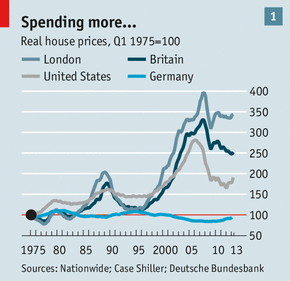
While in the US, the private equity firms are responsible for escalating  home prices since the end of 2012, in the UK, the government is fanning a housing bubble. Since the UK government has chosen the austerity path, there's no economic growth other than that created by a housing bubble.

The Economist chart at left shows that the bubble in UK's home prices were far greater than that of the US. Yet when it popped, the correction has been far less severe than that of the US. Surely this can't be right unless the policymakers have tampered with the natural correction process.

Even the two Economist charts below show that the UK economic recovery has been far weaker than the US recovery given that its investment has collapsed. George Osborne, the Chancellor of the Exchequer, was kidding himself when he claimed that UK's austerity measures were a success. In these end-of-cycle times, no measures can be called a success. Stimulus only buys time and store up more troubles ahead while austerity delivers immediate failure.


Indeed 9.7 million households in the US are still under water. In the UK, two programmes, Funding for Lending and Help to Buy, to facilitate home purchases are responsible for the continued increase in UK home prices. One programme helps the financier by giving them access to cheap credit. The other assists the buyers by giving government guarantee for loans and enabling the buyers  to put down a 5 percent deposit on a newly built property.

The situation in the UK is more pressing as its government is relying solely on the home property market to shore up the economy. But it's not surprising given that the UK economy has been reliant on the financial services industry since Thatcher's days. As financial services all over the world continue their shrinking act, economies with significant exposure to such services will suffer greatly. David Cameron should have called for an early election early next year while the going is good.


Now in any country, whenever there's growth, the credit outstanding will likewise increase. China's August sales industrial output increased by 10.4% and auto sales by 11%. Check! Its new credit doubled over that of previous month. US auto sales continue to increase month after month. Check! Leases (with no ownership rights) made up 26% of sales as compared to 20% before the recession and auto and student loans keep on reaching new highs at the expense of credit cards (see Bloomberg chart of the auto loan secondary market at left and Quartz chart below for new auto loan debt). The American consumers are tightening spending on  goods and services in order to splurge on auto.


Student-loans-Home-equity-credit-lines-Auto-Credit-Card_chart

Beyond the pretense of growth, the economy is actually surviving on debt support. As we remember the 5th anniversary of the recession, bear in mind that it's debt that we should be actually feting.

Tuesday, August 20, 2013

The true role of a central bank

At the Princeton graduating ceremony in June 2013, Ben Bernanke in his commencement address admitted to the graduating students how economics had failed to read the future:
“Economics is a highly sophisticated field of thought that is superb at explaining to policymakers precisely why the choices they made in the past were wrong. About the future, not so much. However, careful economic analysis does have one important benefit, which is that it can help kill ideas that are completely logically inconsistent or wildly at variance with the data. This insight covers at least 90 percent of proposed economic policies.”
The prognosis failure is a serious indictment of the economics profession. Yet Bernanke had the gumption to claim that economics was able to correctly explain the past. Had this remark been made of any other knowledge discipline, that discipline would have been ridiculed for its claimed robustness despite failure in predicting the future. As for the past, anyone can rationalise why things unfolded any which way. In fact, economists are no different from lawyers, every one of them believes in the correctness of his own opinion despite wide and deep differences between every one of them. The only valid test for an economist's opinion is how close it is in predicting the future, and in this respect most economists' reasoning would fail scrutiny.

With this kind of shaky grasp of major economic events, economists are ill suited to the task of running a country's central bank. You don't need an economist who is too clever by half to control the monetary policy of a country. Instead the job must be made foolproof enough for a fool to handle it.

But an economist, or anybody for that matter, can run a commercial bank because money is the easiest thing to sell, or rather lend. You really don't need to convince buyers to buy as money sells by itself. The only time you can't sell money is when prices are falling because the collateralised asset will be worth much less than the borrowed amount. That's why banking requires persons with conservative demeanour, not flamboyant salesmen nor smart brains. As banking uses other people's money (OPM), technically there's no limit on how much you can borrow and lend. But more loans lead to more risk. Herein comes the role of the central bank, that is, to ensure that all the lenders in the country do not borrow and lend money beyond what they can absorb in potential losses.

As for a central bank, do we need it in the first place? In my earlier post, I've argued that the objectives of the Fed as set out by Congress are all unattainable. Those objectives however don't include the received wisdom about the role of a central bank, that is, as a lender of last resort. This is equally wrong because first, it distracts the central bankers from their real role and second, it requires colossal financial resources.

As a lender of last resort, a central bank subverts the role of the executive and the legislative assemblies as only these two branches of government have the right to decide whether the government should bear the cost of massive bank bailouts. A central bank is not answerable to the electorate and cannot spend money willy-nilly even though it can print as much money as it wants. Printing money and spending money are two unrelated issues which have confused many economists. If printing can be equated with spending, Obama wouldn't have any problem with sequestration.

What then should be the role of a central bank? The US used to live without a central bank for a long time. In fact, the Federal Reserve was only set up in 1913. Before the existence of the Fed, the only semblance of a central bank that the US ever had was the short-lived First and the Second Bank of the United States (BUS) which were chartered in 1791 and 1816. These were private banks run on a commercial basis but both didn't last beyond their 20-year charters. They didn't get their short lives extended primarily because many people were envious of private organisations enjoying benefits from the federal government. The First BUS wasn't really a central bank in the modern-day sense as its original purposes were to issue notes, pay off the war debts as well as offer commercial loans at a time when there was a dearth of commercial banks. Its notes were in demand as they were accepted for tax payments.

Soon after the demise of the First BUS, the War of 1812 erupted between the US and Britain, stimulating the need for money. Many state banks were established leading to the proliferation of their own unique banknotes, and in its wake, rising inflation. The problem was compounded when the banks of the southern states suspended redeemability in specie (gold or silver coins). Because of this crisis, the US government decided to reestablish the BUS.

As the US government kept its deposits with the BUS, its banknotes had an implicit sovereign backing, enabling them to be accepted at face whereas those of other banks would be discounted. This function of providing a uniform currency however is not the sole preserve of a central bank; the Treasury can perform this role. The easiest way of effecting this is for the government to back the currency. Demand can be created by insisting that taxes be paid using the bank's notes. Had the US government in the early years of the republic settled on a uniform currency, the confusion created by having to fix the discount rate of other banknotes or trying to figure out whether the banknotes were valid would have been unnecessary.

Another central banking role performed by the Second BUS is more relevant. As the Second BUS was the collecting agent for the federal government revenues, it received a large volume of state banks' banknotes. Also, the Second BUS monitored the foreign exchange rate of the US dollar. If the rate went down, it meant that there was too much money (or credit), so it would redeem the banknotes of the respective state banks in specie. As a result, the state banks tended to be cautious in making new loans as it would mean more of its banknotes would be in circulation and a higher need for specie should the banknotes be redeemed.

This role, that is, ensuring that banks don't increase their lending indiscriminately is more important than being a lender of last resort. As mentioned earlier, banks have a morbid tendency to keep increasing their loans since the source of funds is other people's money. Without adequate checks from the central bank, the leverage ratio would quickly multiply, creating a debt mountain that will eventually collapse. Had a central bank carried out its more important role of crimping credit creation in the first place, a lender of last resort role is superfluous.

A good analogy is to picture the central bank as a prison warden and the banks as prisoners. The prisoners are always on the lookout for escape, which in the case of banks means to lend more and more using OPM. The warden's job is to curtail such tendencies through regular checks and audits. For those that manage to break out, the warden has to impose penalties upon capture. The demands imposed on these tasks require the full-time attention of a warden, to wit, a central bank.

A monetary collapse is further facilitated in a specie based monetary system. Actually a specie based system can never be fully backed by specie, typically represented by gold or silver or both, since there is never enough gold or silver to back all the currency notes in circulation. It's an anachronistic system which should have been abandoned long ago. This was demonstrated by the 1819 panic, the first financial crisis in the US.

In this panic the Second BUS was not irreproachable. Along with the state banks, it contributed to the 1819 panic because of excess debt. Napoleon also sowed the seeds of this crisis. Because of Napoleon's need for cash for his European wars (1803-1815), he sold Louisiana — actually all or part of 15 states right from the Canadian border to the Gulf of Mexico — to the US government for $15 million in 1803 (see the orangish bit on the Wikipedia map below). With that, the barrier to the westward expansion of the US was lifted. Also because of the Napoleonic Wars, the US gained from trade surpluses arising from exports to Europe but as the wars ended, Europe made a recovery in its agricultural production in 1817. Cotton also had a new competitor from India, resulting in big drops in cotton prices. The surpluses now turned into a deficit, causing specie to outflow. Furthermore, the US government in 1818 wanted to redeem in specie $2 million worth of bonds that had been raised for the Louisiana purchase. This meant that the credit overextended during the surplus years had to be called in, causing farms and businesses to foreclose.

File:LouisianaPurchase-fr.png


We can glean two important lessons from the crisis recovery. First, the policymakers suspended specie redemption, thus expanding credit. Any credit contraction crisis can be solved by unshackling credit provided there is enough consumption (people with incomes) to offload capacity. Otherwise the excess credit would go towards funding asset investment which will be written down once deflation takes root. Second, relief was extended to debtors instead of creditors, through the Relief of Public Land Debtors Act of 1821 in which buyers of government land were allowed to keep the proportion of land they had paid and relinquish the balance.

But in the present crisis, the government has gone out of its way to protect the banks. The creditors are the winners, and winners will continue to win as long as we are still in the same Kondratieff Wave. An absence of government help represents only a minor setback to the winners but to the losers, that is, the borrowers, it can be a difference between living on food stamps and living on food kitchens.

The 1819 panic was however a mild foretaste of the more calamitous 1837 panic. Even before the Second BUS's charter lapsed in 1836, the federal government had started transferring its deposits to the state banks from 1833. Flushed with these deposits, the state banks went on a lending binge, especially in financing the westward expansion land sales. These land sales enabled the US government to pay off all its debts — probably the only time it was able to so. However whenever a government has its accounts in surplus, unless it's a small city-state, the surplus spells economic troubles ahead as the private sector would've been deep in debt. By 1836, President Andrew Jackson, troubled by deposits not backed by specie insisted that land sales be made in specie. The specie was withdrawn from many banks and deposited with the land offices or banks of the western border states. As a result the banks suffering from specie withdrawals had to curtail their lending by calling in their outstanding loans, leading to a drastic drop in credit.

Exacerbating this situation was the canal and railway booms — remember that the US had a late start in canal building relative to Britain but its railways, or railroads as the Americans call them, were still in their early stages as reflected in their use of iron instead of steel — in which debt was the driving force. Although no records of credit issued were available, we can safely assume, given the three major investment mania of land, canals and railways running concurrently, that credit outstanding was substantial and had to fall drastically. It was this fall that led to a 7-year deflation, which actually was the first Great Depression.

Economic recovery was only felt in 1844 when trade revived as a result of crop failure in Europe, and debt liquidation no longer took hold. The repeal of Britain's Corn Laws in 1846 fostered the growth of US grain export. Elsewhere on the European continent, bad harvests in 1845 and 1846, followed by restrictive monetary policies to slow the loss of reserves led to the breakout of revolutions which almost toppled many governments across several countries.

In the US, recovery was further boosted by the Mexican-American War (1846-1848), the victory of which allowed the US to seize from Mexico territories ranging from Texas all the way to California. The new territories would lift the economy much later but for now, the immediate boost came from the war spending. In 1847 the federal deficit increased to $31 million, the largest deficit since the founding of the US Republic. Defence alone soaked up $48 million of the $61 million spending in that year. The deficits regressed but continued till 1849, at a time when the norm was federal surpluses arising from land sales. Now, who said that military spending or a budget deficit could suppress the economy? The deficits created credit or money but in the present crisis, that option is no longer available as there is no silver lining, in the form of future income windfall, to offset the massive debts that most governments have piled on.  The Second Kondratieff Wave technologies of railways (steel-based) and telegraph appeared right on cue to link the vast distances from the Atlantic to the Pacific, symbolised by the pounding in of the Golden Spike in Utah in 1869.

In all these events, no central bank was needed to hasten the recovery process. Again important lessons cannot be missed on how the impact of the depression was mitigated. A short-lived Bankrutptcy Act became law in 1841 though it was repealed in 1843 but within its brief existence, it managed to wipe out $450 million worth of debts owed to a million creditors. Though it was the second bankruptcy act, it was the first to provide for both voluntary bankruptcy and individual debtors instead of just merchants and traders. Still, it discouraged investors from making new loans though the lessons from history tell us that their fears will vanish once good investment opportunities appear. In alleviating the sufferings, borrowers deserve more assistance than creditors.

In a future post, we'll continue with how the Fed came to being following a crisis that was resolved by a lender of last resort and how that continued to guide the Fed's actions. The Fed has no memories of how curbing of runaway credit growth would've been the more appropriate role for it.

Monday, August 19, 2013

Why debt will not burn away

If the current monumental debt load refuses to be wiped out, why not set fire to the whole lot and the whole world would be free of the debt burden. It sounds so simple that it makes one wonder why politicians and policymakers are so dumb as to overlook this obvious solution. Well, as the old adage has it, "If it's too good to be true, it probably, no, make it, surely is."

Ambrose Evans-Pritchard, an economics columnist with Britain's Daily Telegraph has been suckered by this nostrum when he writes the following blog piece, "Just set fire to Japan's quadrillion debt", that was published on 9th August 2013:
As you may have seen, Japan’s public debt has hit one trillion quadrillion yen. That is roughly $10 trillion. It will reach 247pc of GDP this year (IMF data).

No problem. Where there is a will, there is a solution to almost everything. Let the Bank of Japan buy a nice fat chunk of this debt, heap the certificates in a pile on Nichigin Dori St in Tokyo, and set fire to it. That part of the debt will simply disappear.

You could do it as an electronic accounting adjustment in ten seconds. Or if you want preserve appearances, you could switch the debt into zero-coupon bonds with a maturity of eternity, and leave them in a drawer for Martians to discover when Mankind is long gone.

Shocking, yes. Depraved, not really.

It also doable, and is in fact being done right before our eyes. That is what Abenomics is all about. It is what Takahashi Korekiyo did in the early 1930s, and it is what the Bank of England is likely to do here (while denying it), and the Fed may well do in America.

Japan’s QE will never be fully unwound. Nor should it be. If a country can eliminate a large chunk of unsustainable debt without setting off an inflation spiral, or a currency crash, or the bubonic plague, there has to be a very strong reason not to do it. I have yet hear such a reason. Though I have heard much tut-tutting, Austro-outrage, and a great deal of pedantry.

It is also what the Romans did time and again over the course of the late empire, though less efficiently, since they did indeed inflate. And no, even that was not fatal. The Roman Empire did not collapse because of metal debasement. It revived magnificently under the Antinones. As Gibbon discovered deep into his opus — and too late to change his title — the Decline and Fall of the Roman Empire took an awfully long time, to the point where the concept is meaningless.

Money is hugely important, but also ultimately trivial. The productive forces of a society are what matter in the end.

Japan’s current debt is roughly the same level as that reached by Britain after the Napoleonic Wars, though Britain produced half the world manufactured goods and controlled half the world’s shipping in the early 19th Century (or at least by 1840), so it had a bigger shock absorber.

Does Japan’s debt matter? Yes, of course it does. A country with a shrinking workforce and surging old-age costs, cannot bear such a load.

The BoJ is currently buying 70pc of the total state debt issuance each month, and my guess is that it will be buying over 100pc before long since the economic rebound will lead to a surge of tax revenues that greatly reduces the fiscal deficit. It will soon enough to be able to carry out some really worthwhile legerdemain.
Now, has Japan burned its debt? On the surface, it appears so but it is really a sleight of hand. Its Japanese government bonds (JGBs) have been taken out of circulation and held by one branch of the government, the Bank of Japan, for debts owed by another branch, its Ministry of Finance. Even if we burn these debts, the Bank of Japan still owes the former holders of the JGBs the exact amount, in the form of BoJ deposits due to them. These cannot be wiped out. The holders of these deposits can even swap them en masse for the US dollars if they no longer have faith in the Japanese yen. That's why Korekiyo Takahashi imposed capital controls in the 1930s when he implemented similar QE measures.

Even assuming that the BoJ buys 100pc of all new JGBs, in return for which the Japanese government will initially own all the new deposits with the BoJ. The Japanese government is not going to sit on these deposits but will spend it to boost the economy. Once spent, the deposits will eventually end up with other financial institutions. So it makes no difference whether old or new JGBs are held by the BoJ because the flip-side of those JGBs, that is, the deposits, will still be held by the financial institutions.

And recent events have proven that Abenomics is really a load of bull. After an initial spurt in economic activity, which really was the outcome of Abe's ¥10.3 trillion stimulus package unveiled in January this year, and aided by a correction in the previous overvaluation of the yen, the Japanese economy will go back to its languid state. Even the yen has refused to depreciate further after finding its steady state. The proposed hike in sales tax next year will dampen the mood further.

There are only three measures that can wipe out the debt, and burning is not one of them. The first option is war and this is becoming a distinct possibility given the worsening economic conditions of both China and Japan. The US which is supposed to play the role of the world's policeman has abdicated this role in the Middle East simply because it is financially broke. The Far East is watching the Middle East with keen interest.

Inflation is an expedient to making the debt become small relative to the economy. Ancient Rome could do that because its productive capacity had reached its limits at a time when population was still growing. Now, Japan is demographically shrinking but its technological capability is not constrained by demographics as it increasingly relies on robots and automation. No, Mr. Evans-Pritchard, it's not just the productive forces of society that matter, it's also its consuming ability. So instead of inflation, it is deflation, which makes debt relatively bigger, that is plaguing Japan. Inflation still besets some countries but they are countries which have lost their productive capacity because of cheap imports from super-efficient producing countries. Do they get their debts whittled down? No, they need more debts to pay for the imports. Inflation is in local currency but debt is in foreign currencies. Talk about a double whammy.

The final option is of course economic growth. But this is no longer possible in the closing phase of a Kondratieff Wave. We can see that debt is growing faster than the economy in virtually all countries.

Can the world slog on in the present manner? Well, if it's too good to be true, it surely is.